Playing Chords - Part II
Updated: Mar 9
In our last post, the question was, how do you play something like this?

In this post, the question becomes, how do you play something like this?
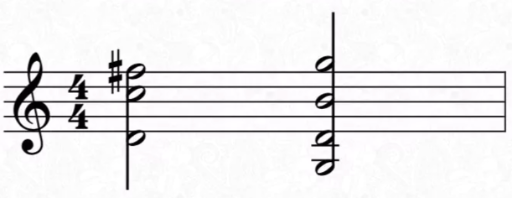
(Image source: https://violinspiration.com/violin-double-stops/)
We are now looking at three notes at once (called a “triple stop”) and four notes at once (called a “quadruple stop”). When you look at a violin or cello bridge (the piece of wood that holds up the strings), you’ll notice that it forms an arch—it’s not flat. With your bow gently on the strings, you can only touch two strings at once, not four.

Then how do you play a three or four note chord? Here are the three main approaches.
1. Divide the chord into two double stops
When you see a four-note chord, split it up into two double stops (group bottom two together, and the top two together), and then play each double stop one right after the other. See this video example of this basic idea.
You can vary how much of the bow you use for each double stop, depending on the piece you are playing and the type of sound you want to produce. For example, you might play the bottom two notes for a short time and linger on the top two notes. Or, you can use an equal amount of bow for each set of notes.
You can use this same approach for playing a three-note chord.
2. Roll your bow to play each note
Another option is to play each note right after the other while “rolling” the bow over the strings, and letting it ring. Here is an example.
For some pieces of music, this type of sound may be preferred over the “two double-stops” approach.
3. Push down firmly with your bow to touch three strings at once
While the bridge gives the strings an arch shape, the violin strings and your bow hairs are flexible. If you press down firmly enough, it is possible to play three strings at once. See this video example.
For playing this way, it is still valuable to practice using the first method above, where you divide the chord into two double stops, as explained the video below.
There are many more advanced techniques and exercises you can use to make triple and quadruple stops sound cleaner or more powerful, but these three main techniques are a great place to start.


